
 +880 1792-669888
  osteopathchiropracticrp@gmail.com
 HOUSE NO 26 ROAD, 04 Shyamoli Ln, Rangpur 5400
Ankylosing Spondylitis: How Chiropractic Treatment Can Help
Waking up every morning with a stiff, aching lower back that takes hours to loosen — and gradually getting worse over the years — is the lived reality of millions of people with Ankylosing Spondylitis (AS) worldwide. In Bangladesh, the condition is widely underdiagnosed, misidentified as ordinary back pain, and frequently undertreated.
The good news is that chiropractic treatment — combined with osteopathic care — offers a powerful, drug-free approach to managing Ankylosing Spondylitis. It cannot reverse the underlying disease process, but it can significantly improve spinal mobility, reduce pain, slow postural deterioration, and give patients their quality of life back.
This article explains what Ankylosing Spondylitis is, how it affects the body, and exactly how expert chiropractic and osteopathic care at Osteopath Center Rangpur in Bangladesh can help.
What Is Ankylosing Spondylitis?
Ankylosing Spondylitis (AS) is a chronic inflammatory autoimmune condition that primarily affects the spine and the sacroiliac joints — the joints connecting the base of the spine to the pelvis. The word "ankylosing" means fusing or stiffening, and "spondylitis" means inflammation of the vertebrae.
In Ankylosing Spondylitis, chronic inflammation causes new bone to form gradually at the edges of the vertebrae. Over time, this can lead to the vertebrae fusing together — creating the characteristic "bamboo spine" appearance visible on X-ray in advanced cases. This fusion progressively limits spinal movement and, if left unmanaged, leads to a stooped forward posture that cannot be corrected.
AS is classified as a seronegative spondyloarthropathy — meaning it is negative for rheumatoid factor but shares features with other inflammatory arthritis conditions. It is strongly associated with the HLA-B27 gene — present in approximately 90% of AS patients.
AS typically begins in young adults between the ages of 17 and 35, affects men more commonly than women (though this gap is narrowing in current research), and is a lifelong condition requiring ongoing management. In Bangladesh, it is widely misdiagnosed as mechanical back pain or disc disease — leading to years of ineffective treatment before the correct diagnosis is made.
Symptoms of Ankylosing Spondylitis
Recognizing AS early is critical — because early intervention significantly slows its progression. The characteristic symptoms include:
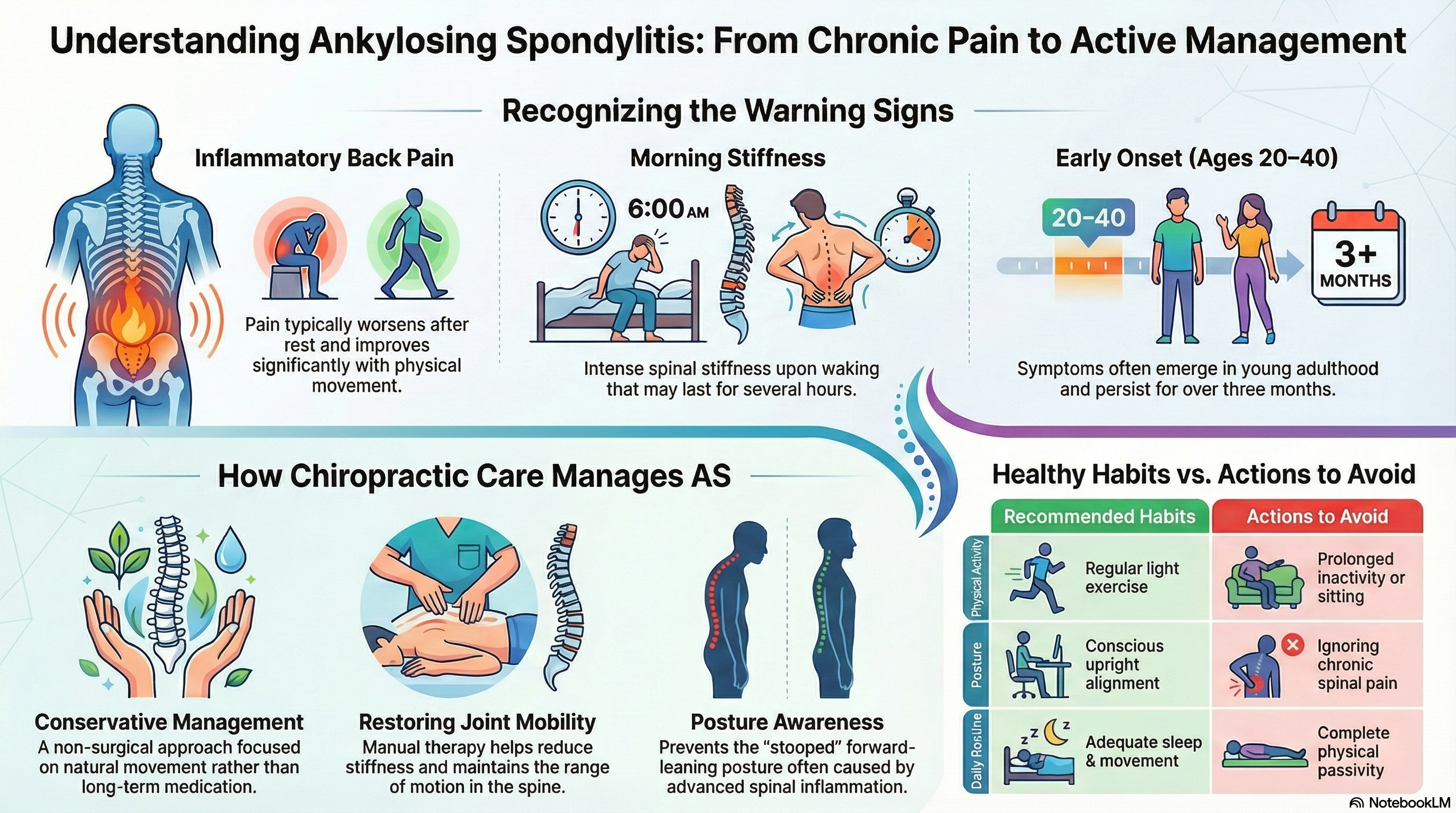
Chronic lower back and sacroiliac joint pain — typically worse in the morning and after periods of rest
Morning stiffness lasting more than 30 minutes — a hallmark feature that distinguishes AS from mechanical back pain
Pain that improves with movement and exercise — the opposite of most mechanical back pain
Progressive loss of spinal flexibility — reduced forward bending, side bending, and rotation
Fatigue — often significant and underappreciated as a symptom of the inflammatory process
Pain and stiffness in the thoracic spine and ribs — causing reduced chest expansion and breathing discomfort
Peripheral joint involvement — hips, shoulders, and knees can also be affected
Enthesitis — inflammation at tendon and ligament attachment sites, particularly the heel (plantar fasciitis) and Achilles tendon
Eye inflammation (uveitis) — in approximately 25 to 40% of AS patients
In advanced cases — forward stooping posture (kyphosis) from progressive spinal fusion
If you have had lower back pain for more than 3 months, it began before the age of 40, it is worse in the morning and better with movement, and it has not been fully explained by disc or joint pathology — Ankylosing Spondylitis should be considered and investigated.
How Ankylosing Spondylitis Affects the Spine Over Time
AS follows a progressive course that can be divided into stages:
EARLY STAGE: Inflammation primarily affects the sacroiliac joints, causing deep buttock and lower back pain. Spinal mobility may be mildly reduced. X-rays may appear normal at this stage — MRI is more sensitive for early sacroiliitis.
MODERATE STAGE: Inflammation progresses up the lumbar and thoracic spine. Bony bridging (syndesmophytes) begins to form between vertebrae. Spinal mobility becomes noticeably restricted. Thoracic involvement may cause reduced chest expansion.
ADVANCED STAGE: Progressive bony fusion — "bamboo spine" — leads to significant loss of spinal movement. The thoracic kyphosis becomes pronounced. Hip involvement may severely limit mobility. At this stage, the spine becomes rigid and highly vulnerable to fracture from even minor trauma.
Understanding these stages is critical because chiropractic and osteopathic intervention is most effective in the early and moderate stages — when movement restriction is driven by muscle spasm, fascial tightening, and joint dysfunction rather than fixed bony fusion.
Conventional Medical Management of Ankylosing Spondylitis
Standard medical management of AS includes:
NSAIDs (non-steroidal anti-inflammatory drugs) — first-line treatment to reduce inflammation and pain
DMARDs (disease-modifying antirheumatic drugs) — for patients with peripheral joint involvement
Biologic agents (TNF inhibitors, IL-17 inhibitors) — for moderate to severe AS not responding to NSAIDs
Corticosteroid injections — for targeted joint inflammation, particularly sacroiliac joints
Surgery — total hip replacement for severe hip involvement, or spinal osteotomy in advanced deformity cases
While medical management is essential for controlling the inflammatory process in AS, it does not address the mechanical consequences of the disease — the muscle spasm, joint restriction, postural deterioration, and movement impairment that significantly reduce quality of life. This is precisely where chiropractic and osteopathic care provides critical complementary benefit.
How Chiropractic Treatment Helps Ankylosing Spondylitis
Chiropractic treatment for Ankylosing Spondylitis is not about curing the disease — it is about maximizing function, minimizing pain, and slowing the mechanical deterioration that AS causes. Here is how expert chiropractic and osteopathic care at Osteopath Center Rangpur addresses AS:
1. Restoring and Maintaining Spinal Mobility
One of the most devastating consequences of AS is progressive loss of spinal movement. Even before bony fusion occurs, the inflammatory process causes severe muscle spasm and joint capsule tightening that dramatically restricts movement.
Chiropractic mobilization — using gentle, controlled movements within the available joint range — helps maintain the mobility of spinal segments that are not yet fused, prevents healthy segments from developing secondary restriction, and reduces the mechanical stiffness that compounds the inflammatory stiffness of AS.
In AS, the goal is not to "crack" the spine with forceful manipulation — but to apply carefully graded, low-force mobilization techniques that maintain movement without provoking the inflammatory response. This is a critical distinction that requires the clinical expertise of a properly trained specialist like Majadul Islam at Osteopath Center Rangpur.
2. Relieving Muscle Spasm and Pain
The chronic inflammation of AS triggers constant reflex muscle spasm in the paraspinal muscles — the erector spinae, multifidus, and quadratus lumborum. This spasm is not just a symptom — it is a major driver of pain, postural deterioration, and movement restriction.
Soft tissue release, myofascial release, and muscle energy technique are applied to relieve this spasm — improving blood supply to the affected muscles, reducing the mechanical compression they place on the already inflamed spinal joints, and restoring normal muscle tone. Dry needling of paraspinal trigger points can provide significant and rapid pain reduction in AS patients who have developed severe muscle tension.
3. Correcting and Slowing Postural Deterioration
The characteristic postural deterioration of AS — progressive thoracic kyphosis (forward rounding of the upper back) and loss of lumbar lordosis — is not inevitable at the rate that AS causes it. Much of the postural change in early and moderate AS is driven by muscle imbalance and fascial restriction that can be directly treated.
Majadul Islam uses thoracic spine mobilization to maintain extension mobility in the thoracic spine, myofascial release of the tight anterior chest and pectoral fascia pulling the spine forward, and targeted strengthening guidance to activate the thoracic extensors — collectively working to slow the kyphotic progression and help patients maintain a more upright posture for longer.
4. Managing Sacroiliac Joint Dysfunction
The sacroiliac joints are the primary site of AS inflammation — and they also develop secondary mechanical dysfunction from the asymmetric muscle tension and altered movement patterns the disease creates. Osteopathic sacroiliac assessment and treatment using gentle mobilization and muscle energy technique can significantly reduce the sacroiliac joint pain and stiffness that is often the most debilitating daily symptom for AS patients.
5. Supporting Breathing and Chest Expansion
In moderate to advanced AS, inflammation of the costovertebral joints (where the ribs attach to the spine) progressively reduces chest wall mobility — making breathing labored and potentially compromising respiratory function.
Rib and thoracic mobilization by an experienced osteopath and chiropractor can maintain costovertebral joint movement, support the deep breathing exercises that AS patients are encouraged to perform daily, and reduce the thoracic stiffness that accelerates rib cage rigidity.
6. Improving Quality of Life and Daily Function
Beyond specific symptoms, the cumulative effect of chiropractic and osteopathic management is a meaningful improvement in daily function — patients move more freely, sleep better (AS notoriously disrupts sleep through morning stiffness), tire less easily, and maintain independence for longer.
Research consistently shows that patients with AS who engage in regular physical therapy and manual treatment alongside medical management have significantly better long-term outcomes than those relying on medication alone.
What Chiropractic Treatment Cannot Do for Ankylosing Spondylitis
Honest patient education is a cornerstone of care at Osteopath Center Rangpur. It is important to be clear about what chiropractic treatment cannot achieve in AS:
It cannot reverse bone fusion that has already occurred
It cannot replace the anti-inflammatory medication required to control the underlying disease process
It cannot be used in the same way as for mechanical back pain — forceful high-velocity manipulation of fused or severely inflamed segments is contraindicated
It cannot prevent disease progression in the absence of appropriate rheumatological management
This is why the best outcomes for AS patients come from a collaborative approach — rheumatological management controlling the inflammatory disease, and chiropractic and osteopathic care managing the mechanical consequences.
What to Expect at Osteopath Center Rangpur for Ankylosing Spondylitis
When an AS patient presents at Osteopath Center Rangpur, Majadul Islam begins with a thorough assessment — reviewing the patient's diagnosis, current disease activity, medication, and imaging — before performing a full spinal mobility and movement analysis.
Treatment is adapted specifically for the AS patient — using low-force mobilization, soft tissue techniques, and osteopathic approaches rather than standard chiropractic HVLA manipulation. The treatment plan specifies realistic goals, addresses the patient's most limiting symptoms first, and is reviewed at every session.
Patients are also given specific guidance on AS-appropriate movement and breathing exercises to perform between sessions — because daily movement is one of the most evidence-based AS management strategies available.
Working alongside your rheumatologist — not instead of them — Majadul Islam provides the complementary mechanical care that medication cannot address, helping AS patients in Bangladesh live better, move more freely, and maintain independence for longer.
Frequently Asked Questions About Ankylosing Spondylitis and Chiropractic Treatment
Is chiropractic treatment safe for Ankylosing Spondylitis?
Yes — when performed by a properly trained specialist who understands AS and adapts techniques accordingly. Standard high-velocity manipulation is modified or avoided in favour of gentle mobilization, soft tissue techniques, and osteopathic methods. At Osteopath Center Rangpur, every AS patient undergoes full assessment before treatment begins.
Can chiropractic treatment stop Ankylosing Spondylitis from progressing?
Chiropractic treatment cannot stop the underlying inflammatory disease — that requires rheumatological management. However, it significantly slows the mechanical deterioration (muscle spasm, joint stiffness, postural change) that AS causes, helping patients maintain mobility and function for longer.
How often should AS patients receive chiropractic treatment?
This varies by disease stage and severity. In active inflammatory phases, 1 to 2 sessions per week may be appropriate for pain management. In stable phases, monthly maintenance sessions are commonly recommended to maintain spinal mobility and prevent mechanical deterioration.
I have been told I have AS but my doctor only gave me medication. Should I also see a chiropractor?
Yes — medication manages the inflammation, but it does not address the muscle spasm, joint restriction, and postural deterioration that significantly reduce daily quality of life. Chiropractic and osteopathic care fills this gap. It is complementary to — not a replacement for — your rheumatological treatment.
Is Ankylosing Spondylitis common in Bangladesh?
AS is likely more common in Bangladesh than current diagnosis rates suggest — because it is frequently misidentified as mechanical back pain or lumbar disc disease. The HLA-B27 gene associated with AS is present in Asian populations, and the condition affects young adults who are otherwise healthy — a combination that often delays diagnosis for years.
Conclusion
Ankylosing Spondylitis is a lifelong condition — but it does not have to be a life-limiting one. With the right combination of medical management to control inflammation and expert chiropractic and osteopathic care to manage its mechanical consequences, AS patients can maintain meaningful spinal mobility, live with significantly reduced pain, and preserve their quality of life for decades.
At Osteopath Center Rangpur, Majadul Islam — Bangladesh's only specialist offering combined osteopathic and chiropractic care — brings internationally trained expertise to the management of complex spinal conditions like Ankylosing Spondylitis. Drug-free, surgery-free, and personalized to each patient's specific needs and disease stage.
If you or someone you know has been diagnosed with Ankylosing Spondylitis — or has had unexplained morning back stiffness for months or years — contact Osteopath Center Rangpur today for a comprehensive assessment.
 Emergency No. : +880 1792669888